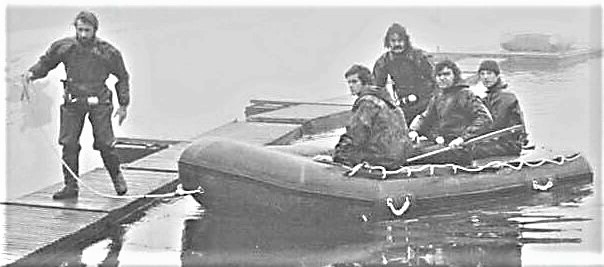
Returning from a compressed air dive in a lake in the 70s.
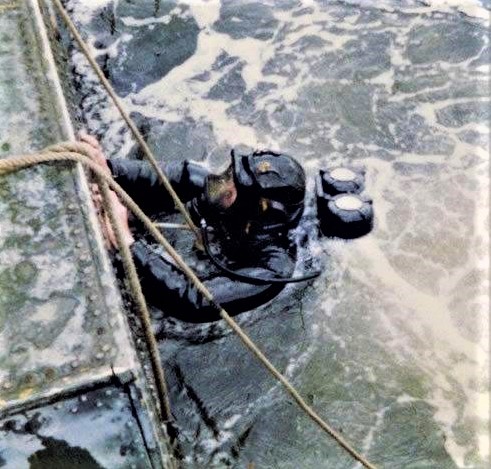
Diving with a dry suit, full face mask and twin compressed air sets. A stepping stone to moving forward to diving with O2 rebreathable apparatus allowing us to swim in towards a target covertly without any trace of bubbles on the surface.
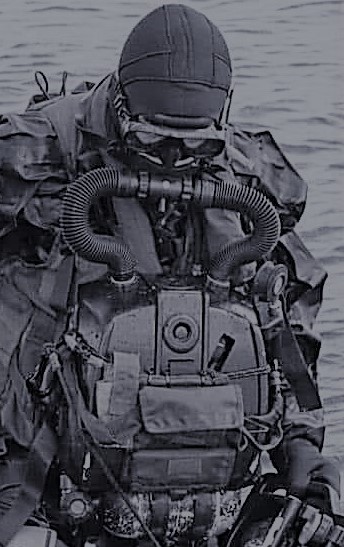
The next step…O2 rebreather diving, on a compass bearing to the target.
In the mid 1970s when I joined amphibious troop (boat troop) in 22 SAS Regiment, we were in the early stages of progressing from compressed air diving (like sports and social diving on holiday) to 02 diving, the ultimate in operational special forces target recce or attack diving.
With all the other commitments of operations, training, courses etc, it would take a few years to get from the basics and onto the advanced…it’s just the way that it was back then.
However, like any course or training in the Regiment, and like any course or training in any unit in the British military, it has to come with humour.
Given that we would be learning the diving trade from the Royal Engineers from the Army, and the Diving Establishments from the Navy, and onto the SBS, the humour was endless.
Diving in the UK winter isn’t fun. The sea is often churned up, the visibility can be nil, and time spent subsurface has to be limited to ensure that everyone remains safe and in good form.
In my years military diving, from ship attacks to subsurface swimming onto oil and gas rigs alongside the SBS, one of the best humourous comments I would hear that has always stuck with me, came from way back in my earlier days.
We were diving off the West Coast of Scotland, minging weather, and we were sitting in a Gemini type inflatable craft with an outboard engine. Two lads ready to dive on the port side, and two ready to dive on the starboard side. The diving supervisor was the coxswain, and the standby diver was sitting in the middle of the craft.
The idea was to dive in pairs, buddied up together by a length of thin cord from arm to arm, with one diver operating the compass board.
One of the lads in the pair was a new troop commander, a commissioned officer. He asked “why is it that we have to leave the craft and tip ourselves over the side into the water backwards?”
With a poker face and without taking a moment to think, the supervisor came back with: “well, if you tip forwards you’ll still be in the boat!”
I have no doubt today that this had been the answer in the Navy for years and years whenever this gullable question would be asked, and I’m sure always raised a laugh.
I was one of those pairs, and after going over the side…backwards…and swimming subsurface on our compass bearing, I was still laughing underwater…so much so, that I had to keep purging water from my facemask as we were swimming.
It was a combination of the quick-fired answer to the question, and the puzzled look on the new troop commander’s face.
After the dive he had to take a bit of ribbing for a good while. He took it really well, he had a great sense of humour anyway, and turned out to be a terrific troop commander.
 Bob Shepherd
Hi Bob,
I hope all is well. I posted this on the RN Clearance Divers Association FB page. My betting is the Coxswain was one Blondie Limbrick. He certainly took the early Regt courses through when they first came to the branch for training. Sadly he died of a heart attack in 2007.
Stay well.
Howard
>
Hi Howard, it’s terrific to hear from you. Yes, Blondie it was ha ha. So sorry to hear of his passing, way too many of our era gone now. Mick Fellows was another, and of course, we got to catch up with him during the Falklands Campaign. All the very best Howard, Bob.