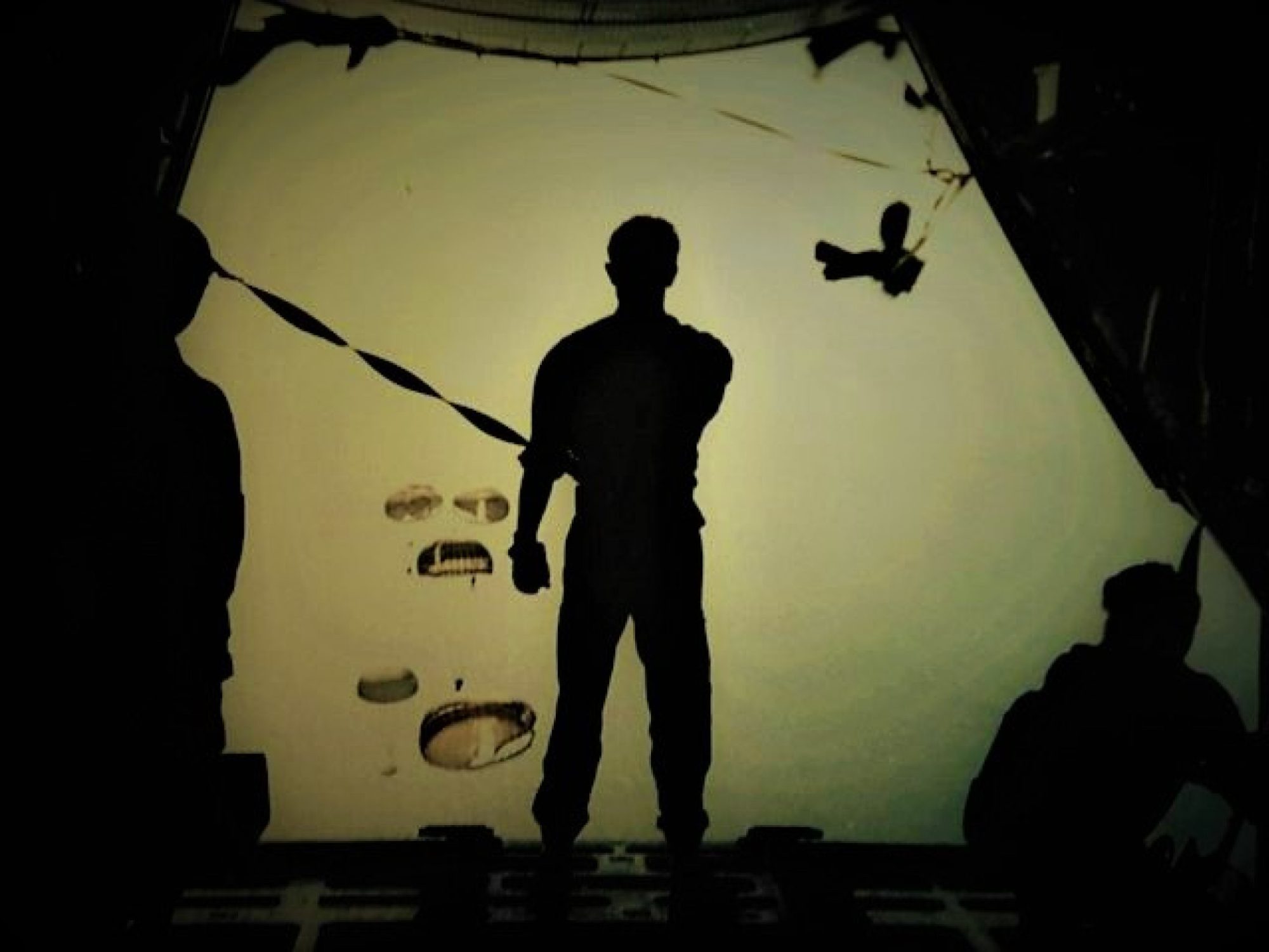
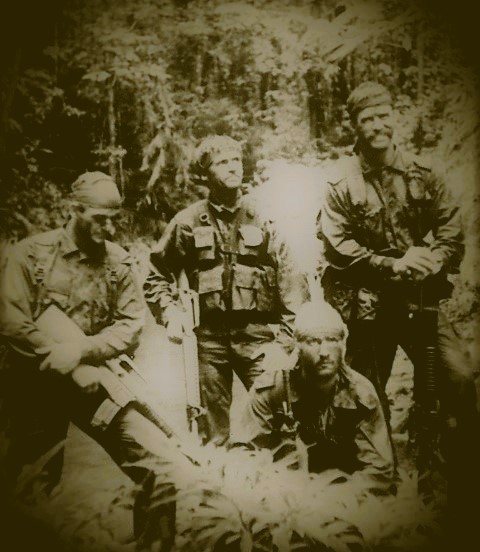
Four men from an 1980s joint SAS/SBS, Australian SAS, and Malaysian SF grouping.
Although the jungles of the world are getting smaller by the day, and therefore the wildlife is finding it more and more difficult to survive without it, if given the chance…either as a soldier or a civilian…get under that canopy and seize the amazing experience of living under the canopy.
I’ve heard for decades now that soldiers of all levels complain about how hard it is to live and operate inside the tropical rainforest.
I completely disagree.
An understanding of the forest and an understanding of yourself is key, and that can only come from realistic training.
The jungle floor gorges on all that sits above it when it dies…including you. Huge hardwood trees crashing to the ground as their root systems strain and break under the tree’s weight and height, versus the ground giving way around it. It could be the heavy rains, the wind…or it’s just that time to become deadfall, taking all the smaller trees around it on its way to crashing to the ground. Animals, birds and bats are all rotting away.
All that dies gets used up as nutrients by the rich jungle floor.
Take that canopy away, the trees have gone, the other plants competing for sunshine and rain are gone, the animals are gone, the waterways are contaminated with mud, and the rich jungle floor becomes no more.
Most people in the world couldn’t care less. As long as what they buy is cheap, and life for them goes on…but for how long?
I first went to the jungle as a 17yr young “green as the jungle ” soldier. It was on mainland Malaya…today’s Malaysia, just above Singapore. We went into the jungle in stages, just for a few days and back to the classroom. That continued for 6 weeks.
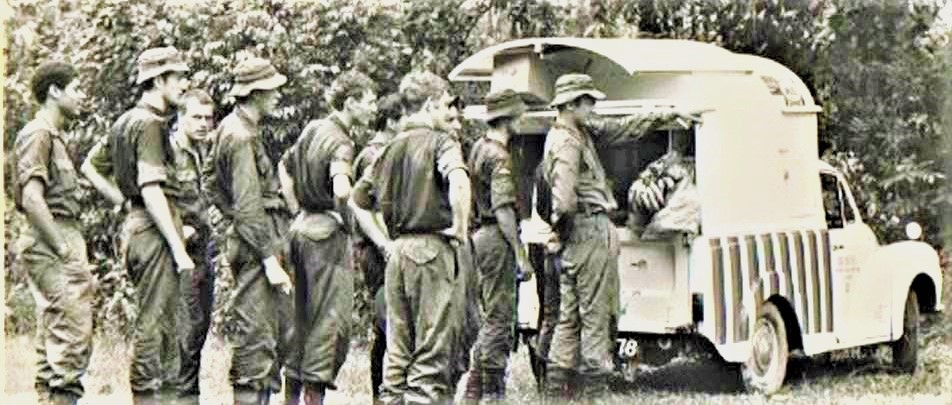
A break in jungle training, I’m second in line 17yrs young…an ice cream or a banana? Kota Tingi, Malaya 1972.
Not a good way to get the best out of the training, and here’s why:
When I went to the special forces, the selection training for the jungle phase was entirely different from the jungle warfare school’s courses of the time.
We flew from the UK, arrived into Borneo, and slept the night in a non-air-conditioned hut open to the elements.
The next morning we flew by helicopter into the jungle LS (LANDING SITE). Off the helicopter and straight into the school house under the jungle canopy (logs as seating, placed on a slope towards a small tributary and covered with a large tarpaulin as a roof to keep off the heavy daily rains of the time).
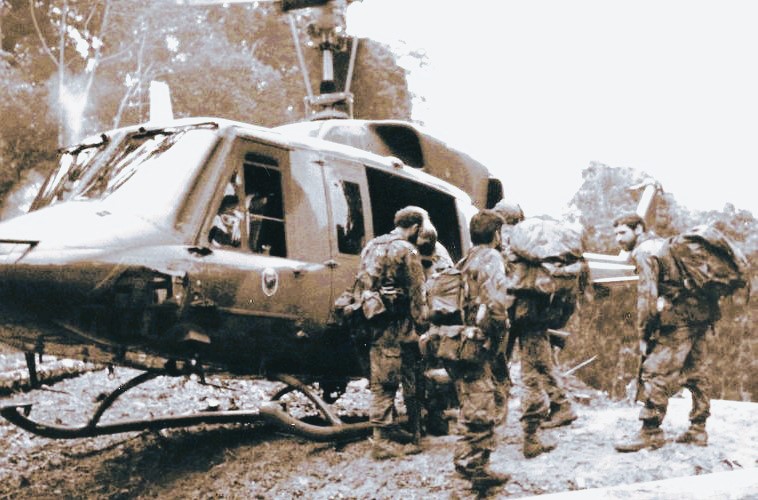
SAS patrol jungle pickup.
We were given an amazing brief, told to go everywhere, including to the hole in the ground toilet…always in pairs. Anywhere away from the base camp tracks, then out on a bearing and returning on a back bearing.
Speak in low tones only.
Place your hammock so that when you’re in it, you are higher than a wild boar should it choose to use you as a target.
Use your parang (machete) in daylight hours only, as the helicopter will not be coming for you at night should you receive a parang bite!
Sterilize all water, and wait the appropriate time for those tablets to work.
Listen to all that is told to you, and you’ll have the chance to put it into practice.
Enjoy every minute, move with the jungle and not against it.
We all remain in the jungle for the next 8 weeks to become at one with the jungle.
Those were just a handful of the things that were told to us. Over the weeks, we would receive lessons on different subjects from jungle navigation to tactics at the schoolhouse, and then go out and put it all together practically.
Being at one with the jungle can only come together if you stay in the jungle…there is no other way.
Before you know it, you’re sleeping like a baby, moving like a predator, slowly slowly catchee monkey, and being at one with the jungle.
There is no feeling like it in the world or indeed in any other environment, which is why the SAS and the SBS test their students under the jungle canopy, for a realistic period. of what was back then, 8 weeks.
At the end of the jungle period, we fly back to the barracks, hot running water, electric kettle for a brew, lights at night, vehicles being driven on roads, speaking in normal tones (which took a while)…we needed none of this, we were in basic mode for 8 weeks solid, and it made us all at one with the jungle.
When I went to the British jungle warfare school in Brunei as the chief instructor way back in 1992, I encouraged the staff to embrace going into the jungle to run the courses full time…not part time as they were doing, and had been doing for decades.
I tried and tried, it wasn’t a popular move. Most of the officers didn’t like the idea, and some of the instructors were against it too.
None of their reasoning was to do with what the students will get out of remaining in the jungle for the whole course…which was no more than a month.

The most important 2 members of staff at the jungle warfare school (Training Team Brunei)…the Ibans.
A lone SAS man alongside a school of infantrymen.
I continued for my time there (2 years) to fight for the students to remain for as long as possible in the jungle.
The best I got in that time, was 16 days in the trees for the Long Range Patrol Course, in my view the most important course at that time. Given all that I was up against, and talk of the jungle school being disbanded under defence cuts, I’ll take that.
When you consider that the instructor’s course was purely in and out, in and out of the jungle for 4 weeks or so, and after that course, the individual will go back to his unit as a jungle instructor…it was nothing short of pathetic, given what could have been achieved. For many on that course over the 2 years that I was there, it was their first time in the jungle, now they’re to go back to their units as instructors!
To me, the cost and time of flying troops from the UK to the Far East to receive jungle training is harder and harder to maintain, given that the MOD bean counters would love nothing more than to take away the jungle school altogether, as they have attempted in the past.
The reason that the SAS/SBS have the jungle as a major test ground for their students is that if you can soldier in the jungle, you can soldier anywhere.
Given that, wouldn’t it be nice as a student travelling all that way to become jungle trained, and therefore at one with the jungle, getting the tick in the box as an instructor…that they would get the chance to spend as much time as possible in that jungle, to then be able to pass on jungle training to their own unit a step up from what they were taught on their course.
Embrace the jungle, it’s an awesome place, it can teach you all about yourself and more…when done correctly.
 Bob Shepherd
As always Bob,
Another excellent article.
Sadly, reducing the length and time on courses, is something that happens much too often and dare I say, dullutes the quality of training delivered to those students on the receiving end and even more so the quality of the instructors in the future.
When will we learn. Train hard, fight easy.
Hallo Bob, Interested to read the stories I get on your e-mails, keep them coming. I am currently reading ‘Siege’ by Ben Macintyre and am enjoying it very much. What a well researched book. Do I gather your are now living in Ohio? Hope that you and yours are well. Best Regards, David Chapman, Malvern. (Aston Villa supporter)
Hi David, so good to hear from you. And so good that Villa are dramatically improved since I lived in Malvern ha ha. Yes mate, we’ve been in the USA for 12 years now, 11 of those were in New York. Hope all’s well your end. Please say hi to anyone who may remember us back in Malvern. Very best regards, Bob.